🎉Find Prospects and Send Cold Emails & LinkedIn Outbound | All in One Place

LinkedIn Marketing Statistics: The Ultimate Guide to B2B Marketing Success in 2026

Table of Contents

LinkedIn Marketing Statistics

80% of B2B leads generated through social media come from LinkedIn – not 20% or 40%, making it the dominant platform for B2B lead generation

LinkedIn receives 1.77 billion monthly visits – making it one of the most active professional networks globally with massive reach potential

16.2% of LinkedIn users are active daily (134.5 million professionals) – understanding daily active users helps set realistic expectations for organic reach

25-34 age group accounts for 50-60% of LinkedIn users – this demographic represents mid-level managers and directors with real purchasing power

44% of LinkedIn users earn more than $75,000 annually – indicating affluent professionals with budget authority and purchasing power

LinkedIn hosts 61 million senior-level influencers and 40 million decision-makers – the exact people who approve purchases and sign contracts

80% of engagement happens on mobile devices – requiring mobile-first content optimization with vertical formats and scannable text

Multi-image posts and carousels generate 6.60% engagement – highest-performing format due to dwell time from swiping through slides

LinkedIn Live generates 7x more reactions and 24x more comments than standard video – biggest engagement multiplier available on the platform

Posts with external links see 50-80% less reach than native content – LinkedIn algorithm penalizes off-platform traffic, requiring “zero-click” content strategy

Average LinkedIn cost per lead: $310 vs Facebook’s $164 – higher upfront cost but generates 2x higher conversion rates, justifying premium pricing

LinkedIn InMail achieves 18-25% response rates vs cold email’s 1-5% – 4-5x better performance due to professional context and spam filter immunity

Connection requests with personalized notes see 93% higher acceptance rates – generic “I’d like to add you” messages are largely ignored by executives

Multi-channel approach (email + LinkedIn + phone) generates 250% higher conversion rates – than single-channel campaigns, creating “surround sound” effect

InMails under 400 characters see 22% boost in response rates – roughly 3-4 sentences, as decision-makers need immediate clarity on value proposition

If you’re serious about B2B marketing, LinkedIn isn’t optional anymore—it’s essential.

But here’s the thing: most marketers are guessing. They post content hoping something sticks. They run ads without knowing what works. They invest time and budget into a platform without understanding the numbers that actually matter.

That ends today.

LinkedIn marketing statistics reveal exactly what’s working right now. These aren’t vague predictions or marketing fluff. These are hard numbers showing you where the opportunities are, what content performs best, and how much ROI you can actually expect.

Whether you’re trying to generate more leads, build brand awareness, or justify your LinkedIn budget to your boss, these statistics will give you the clarity you need to make smarter decisions.

Let’s dive into the data.

📊 Stop Guessing, Start Booking Meetings

H2: Our LinkedIn outbound engine delivers 15-25% response rates with proven targeting, campaign design, and scaling methods.

Why LinkedIn Marketing Statistics Matter More Than Ever

The B2B landscape has completely changed. Cold calling is dying. Email deliverability is harder than ever. And traditional advertising just doesn’t cut through the noise anymore.

Meanwhile, LinkedIn has evolved from a simple networking site into the most powerful B2B marketing platform in existence. With over 1.2 billion members worldwide, it’s become the go-to place where professionals make purchasing decisions, discover solutions, and engage with industry content.

But here’s what makes LinkedIn different: 80% of B2B leads generated through social media come from LinkedIn. That’s not 20% or 40%. It’s 80%. If you’re not leveraging this platform with a data-driven strategy, you’re leaving massive opportunities on the table.

The challenge? LinkedIn’s algorithm has become incredibly sophisticated. What worked two years ago doesn’t work today. The only way to stay ahead is by understanding the current benchmarks, engagement patterns, and conversion metrics that define success in 2025.

LinkedIn User Statistics: Understanding Your Audience

Before you can market effectively on LinkedIn, you need to understand who’s actually using the platform. And the numbers here are powerful.

The Scale of LinkedIn’s Professional Network

LinkedIn isn’t just big—it’s massive. The platform receives approximately 1.77 billion monthly visits, making it one of the most active professional networks on the planet. But size alone doesn’t tell the whole story.

What matters more is engagement. About 16.2% of LinkedIn users are active daily, which translates to roughly 134.5 million professionals logging in, scrolling their feed, and engaging with content every single day. These are your potential customers, partners, and brand advocates showing up consistently.

And the platform keeps growing. 3 new members join LinkedIn every second. That’s over 250,000 new professionals every day expanding your potential reach.

Who’s On LinkedIn?

Demographics matter because they tell you whether your target audience is actually on the platform. And for B2B marketers, the data is incredibly promising.

The largest demographic on LinkedIn is the 25-34 age group, accounting for approximately 50-60% of users. This is crucial because this age range represents mid-level managers, directors, and decision-makers with real purchasing power. They’re not entry-level employees—they’re the people who actually influence and approve B2B purchases.

Following this, the 35-54 age bracket represents another 20% of users. Together, these two groups make up the vast majority of LinkedIn’s active users and represent the core of B2B decision-making power.

From a geographic perspective, the United States leads with over 234 million members, but LinkedIn is truly global. India has 148 million users, Brazil has 83 million, and China has 58 million. If you’re selling internationally, LinkedIn gives you access to decision-makers across every major market.
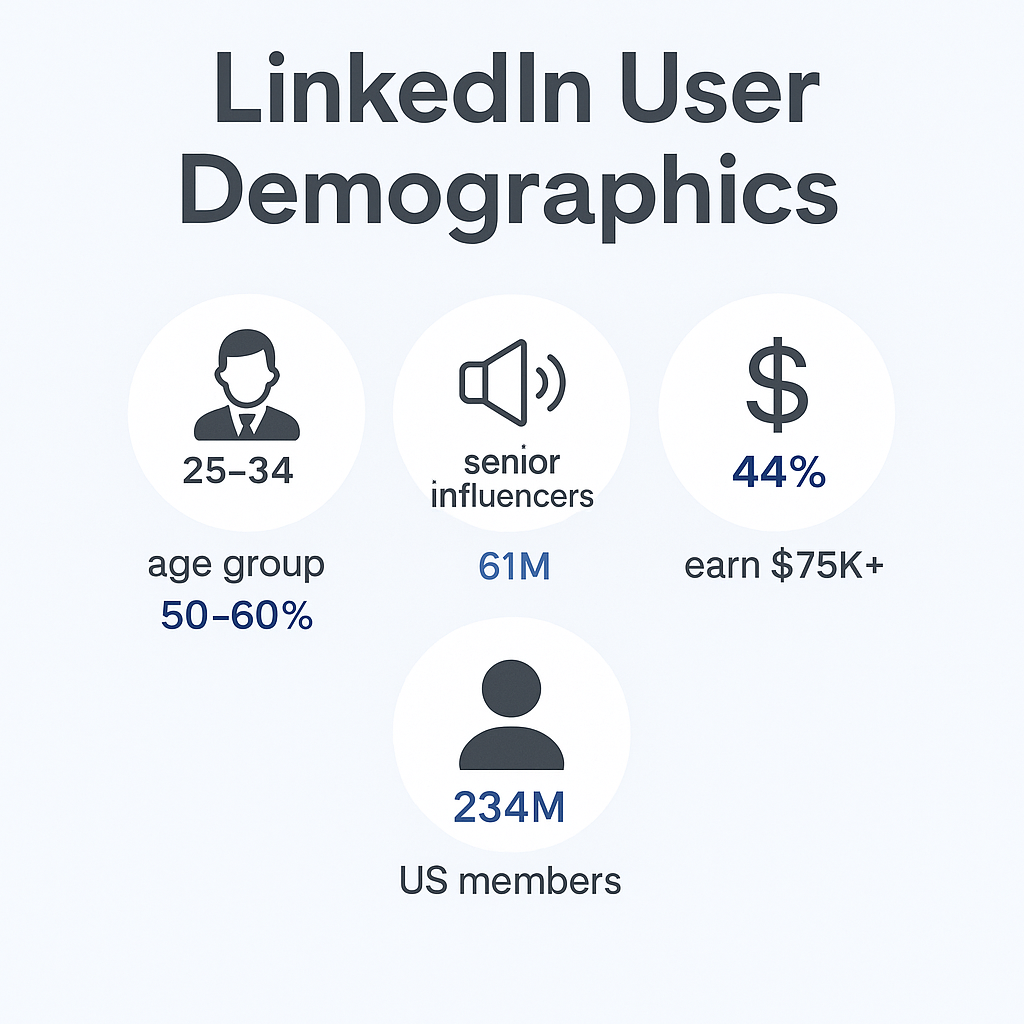


And here’s the financial angle that really matters: 44% of LinkedIn users earn more than $75,000 annually. These aren’t just professionals scrolling during their commute—they’re affluent individuals with budget authority and purchasing power.

Most importantly, LinkedIn hosts 61 million senior-level influencers and 40 million decision-makers. These are the exact people who approve purchases, sign contracts, and greenlight new vendor relationships.

 🎯 Reach 61M Senior Decision-Makers

We build complete outbound strategies targeting active buyers, not dormant profiles—with campaigns that actually convert.

The Mobile-First Reality

Here’s something that changes everything about how you should create content: approximately 80% of engagement happens on mobile devices.

Think about what that means for your content strategy. Your target audience isn’t sitting at their desk carefully reading your 2,000-word LinkedIn article on a 27-inch monitor. They’re scrolling during their commute, between meetings, or while waiting for coffee.

This means:

  • Your headlines need to grab attention in 2-3 seconds
  • Images and videos must be optimized for vertical mobile screens
  • Text needs to be scannable with short paragraphs and clear formatting
  • The first few lines of your post are critical because that’s all mobile users see before “read more”

If your content isn’t mobile-optimized, you’re essentially invisible to 80% of your potential audience.

Content Performance Statistics: What Actually Works

Creating content on LinkedIn feels like throwing darts blindfolded. You post something, hope it performs well, and then wonder why some posts blow up while others die in obscurity.

The statistics reveal exactly what’s working right now. And some of these numbers will surprise you.


 increase in purchase intent, even if users don’t click.

This is the “priming The Content Format Hierarchy

Not all content formats are created equal. LinkedIn’s algorithm and user behavior patterns show clear winners and losers.

Multi-image posts and PDF carousels generate the highest engagement rate at 6.60%. Why? Because they require active participation. Users have to swipe through slides, which signals to the algorithm that the content is engaging. Plus, reading a 10-slide carousel takes time, which increases what LinkedIn calls “dwell time”—a crucial ranking factor.

Here’s the tactical takeaway: stop sharing links to your blog posts. Instead, repurpose that content into a PDF carousel that users can consume without leaving LinkedIn. This “zero-click” approach keeps users on the platform, which the algorithm rewards with more reach.

Native documents come in second at 5.85-6.10% engagement. These work particularly well for data-heavy content, research findings, or technical guides where you need to present detailed information in a visual format.

Video content achieves 5.60% engagement and is climbing fast. But here’s what’s interesting: the type of video matters. Short-form videos (30-90 seconds) see completion rates above 60%, while anything over 2 minutes sees a sharp drop-off. The key is getting to the point quickly while still delivering value.

LinkedIn Live video generates 7x more reactions and 24x more comments than standard video. If you’re not doing live content yet, you’re missing one of the biggest engagement multipliers on the platform.

Single image posts average 4.85% engagement. They’re solid but not spectacular. Use them for announcements, culture content, or quick updates—but not for your primary thought leadership content.

Text-only posts have dropped to 4.00% engagement. While they’re the easiest to create, they struggle to stop the scroll in a visually rich mobile feed. They still work for provocative questions or contrarian takes, but they’re no longer the reliable format they once were.

Video Strategy: Vertical vs. Horizontal

With video becoming crucial, there’s one technical debate that confuses everyone: should you use vertical or horizontal video?

The data gives us a clear answer, but it depends on your goals.

For organic reach, vertical video (9:16 aspect ratio) performs better or on par with horizontal. Why? Because it occupies the full mobile screen, creating an immersive experience without distractions. When 80% of users are on mobile, vertical video simply makes sense.

For paid advertising, horizontal video (16:9) actually outperforms vertical in terms of cost efficiency and view-through rates. This is likely because paid placements are often viewed on desktop devices in office environments.

The practical strategy: Create organic content in vertical format for mobile users, but use horizontal or square (1:1) video for paid campaigns.

The “Zero-Click” Content Mandate

Here’s something crucial that most marketers get wrong: posts containing external links can see 50-80% less reach than native content.

LinkedIn wants to keep users on the platform. When you drop a link to your blog, you’re essentially asking LinkedIn to send traffic away from their site. The algorithm doesn’t like that.

The solution? Embrace “zero-click” content. Give the entire value proposition within the post itself. Use carousels, videos, and images that deliver complete ideas without requiring users to click away.

“But wait,” you’re thinking, “how do I generate leads without sending people to my website?”

Smart marketers use a different approach. Instead of linking, they create valuable content and then say something like: “Comment ‘GUIDE’ and I’ll send you the full framework.” This does three things:

  1. It massively increases your comment count, which signals high engagement to the algorithm
  2. It pushes your post into the feeds of everyone who comments’ networks
  3. It gives you explicit permission to DM prospects, opening a direct line for conversation

This strategy turns content into conversation, which is exactly what social selling is all about.

LinkedIn Advertising Statistics: Understanding Paid Performance

Organic reach is powerful, but paid advertising is where LinkedIn truly shines for B2B lead generation. The numbers here are eye-opening.

The Cost Reality

Let’s address the elephant in the room: LinkedIn ads are expensive. The average cost per lead on LinkedIn is around $310, significantly higher than other platforms. Facebook might generate leads at $164, and Google at similar rates.

But here’s what those numbers don’t tell you: LinkedIn leads are worth more.

When you’re selling a $50,000 enterprise software solution or a $100,000 consulting engagement, a $310 cost per lead is completely justifiable. The lifetime value (LTV) of a B2B customer is exponentially higher than a B2C customer on Facebook.

40% of B2B marketers rate LinkedIn as the most effective channel for driving high-quality leads. Not “one of the best”—the absolute best. That premium you’re paying translates directly into better lead quality, higher conversion rates, and ultimately more revenue.

Conversion Rates That Justify the Investment

Here’s where LinkedIn advertising really proves its value: LinkedIn ads generate 2x higher conversion rates compared to other social platforms.

Think about what that means. You’re not just paying more per lead—you’re getting leads that are twice as likely to convert. The math actually works out in your favor when you consider the full funnel.

Even more impressive: 80% of B2B social leads come from LinkedIn. X (formerly Twitter) generates just 13%, and Facebook contributes a mere 7%. If you’re allocating your B2B ad budget anywhere other than LinkedIn first, you’re statistically making the wrong choice.

The Purchase Intent Factor

One of the most underrated LinkedIn advertising statistics: exposure to a brand’s LinkedIn ads creates a 33%effect” in action. Users might not click your ad today, but they’ve seen your brand. When your sales team reaches out via email or LinkedIn message later, that warm familiarity dramatically increases response rates.

This is why sophisticated B2B marketers use LinkedIn ads for more than just direct lead generation. They use it for brand awareness and account-based marketing (ABM), ensuring their target accounts have multiple touchpoints with their brand before any sales conversation happens.

Ad Reach Potential

LinkedIn ads can now reach 14.6% of the world’s adult population, with a 17.1% year-over-year increase in ad inventory. As more professionals join the platform and engagement increases, your potential audience keeps expanding.

The strategic opportunity here is using data analytics to identify your ideal customer profile (ICP) and then using LinkedIn’s sophisticated targeting to reach exactly those individuals. You’re not wasting impressions on consumers who will never buy. Every dollar is spent reaching actual decision-makers in your target accounts.

Sales Outreach Statistics: LinkedIn vs. Traditional Methods

If you’re still relying primarily on cold email for B2B outreach, these statistics will change your strategy immediately.

InMail vs. Cold Email: The Response Rate Battle

LinkedIn InMail achieves response rates between 18-25%, while cold email struggles to break 1-5%. Let that sink in.

You could send 100 cold emails and get 2-3 responses. Or you could send 100 LinkedIn InMails and get 18-25 responses. The difference isn’t marginal—it’s massive.


Even conservative benchmarks put InMail at 10.3% response rates, which is still double what cold email delivers. Why such a dramatic difference?

First, InMail operates in a “walled garden” immune to spam filters. Your message goes directly to the recipient’s LinkedIn inbox without battling Google’s increasingly strict authentication protocols.

Second, LinkedIn is a professional networking environment. People expect business conversations here. An InMail feels natural, while a cold email to a work inbox often feels intrusive.

Third, InMail comes with social proof. Recipients can see your profile, mutual connections, and professional background before deciding whether to respond. You’re not a faceless sender—you’re a real professional with credibility.

The Power of Personalization

Here’s something that separates average performers from top performers: connection requests with personalized notes see acceptance rates 93% higher than generic requests.

The default “I’d like to add you to my professional network” message is basically ignored by executives. But a message that references something specific about their company, a recent post they made, or a mutual connection opens doors.

Similarly, InMails that include at least two unique profile details drive 15% higher engagement. Simply using someone’s first name isn’t enough anymore. Reference their recent job promotion, congratulate them on a company milestone, or mention a shared alma mater.

Message Length Matters

InMails under 400 characters see a 22% boost in response rates. That’s roughly 3-4 sentences.

Decision-makers don’t have time to read essays. They need to immediately understand: Who are you? Why are you reaching out? What’s in it for them?

Get to the point quickly. Lead with value. Make it easy to respond.

Targeting “Open to Work” Profiles

Here’s an underutilized strategy: targeting profiles with the “Open to Work” banner yields 37% higher response rates.

While this feature is typically used by recruiters, smart B2B marketers recognize an opportunity. People who are “Open to Work” are actively monitoring their LinkedIn activity, responding quickly to messages, and generally more engaged on the platform.

If your service helps people in career transitions—like productivity tools, professional development, or career coaching—this is a goldmine. Even if you’re selling something else, these users are simply more responsive as a cohort.

Multi-Channel Approach: The 250% Multiplier

Here’s where things get really interesting. LinkedIn doesn’t exist in a vacuum. The most sophisticated sales teams use it as part of an integrated outreach strategy.

Outreach sequences that combine email + LinkedIn + phone generate conversion rates 250% higher than single-channel campaigns. Why?

Because B2B buyers engage with 10+ channels during their decision process. If you’re only present on one channel, you’re invisible for 90% of their journey.

Think about it from the buyer’s perspective. They see your LinkedIn connection request (touch #1). Later that day, they receive your email (touch #2). A few days later, they see your comment on an industry post (touch #3). Then they receive your InMail with a video message (touch #4). Finally, you call and they already recognize your name (touch #5).

This “surround sound” effect builds familiarity and trust. By the time you have an actual conversation, you’re not a stranger—you’re someone they’ve encountered multiple times across different contexts.

 🚀 3X Your Pipeline Without The Setup

Our LinkedIn Outbound Service Handles Everything: Targeting, Campaigns, And Safe Scaling Methods

The tactical sequence that works:

Day 1: Visit their profile (soft touch) + send personalized connection request Day 2: Send email referencing the LinkedIn request Day 3: If connected, send a native video message (15-30 seconds) Day 5: Call them, referencing the video in your voicemail

This creates multiple touchpoints while feeling professional rather than aggressive. And the data shows it works.

Data Analytics and Big Data in LinkedIn Marketing

The smartest marketers aren’t just using LinkedIn—they’re mining it for intelligence.

Data mining on LinkedIn means extracting behavioral signals from millions of interactions to predict buying intent. It’s not about gathering more data; it’s about gathering the right data.

For example, tracking when decision-makers at target accounts engage with competitor content. If someone likes, comments, or shares a competitor’s post, they’re self-identifying as interested in that solution category. This is intent data, and it’s incredibly valuable for lead generation.

Data analytics takes this further by using tools to aggregate these signals at scale. Instead of manually checking if prospects are engaging with industry content, sophisticated sales teams use platforms that automatically surface these signals and trigger outreach at the perfect moment.

The Role of LinkedIn Groups in Data Mining

Here’s something most marketers get wrong about LinkedIn groups: they think groups are for posting content and generating engagement. They’re not.

Posting in groups is largely ineffective in 2025. Reach is throttled, and notifications are often muted. But here’s what groups are perfect for: data mining.

Group membership is self-identification. When someone joins “SaaS Founders Network” or “Python Developers London,” they’re explicitly telling you what they care about. This is 100% accurate psychographic data.

The smart play? Use group membership as a warm hook for outreach. “Hi [Name], I saw we’re both members of the SaaS Founders group. I loved the recent discussion on churn reduction…” This shared affiliation builds instant rapport.

Big Data and Active Users Analysis

Active users LinkedIn data reveals patterns that casual users miss. For instance, profiles that post regularly (at least once per month) tend to respond 30% faster to outreach than dormant profiles.

This is why sophisticated sales teams filter prospects by recent activity. They’re not wasting time on people who haven’t logged in for six months. They’re focused on active users who are actually seeing their messages and engaging with content.

Tools that leverage big data can analyze millions of profiles to identify patterns like:

  • Job change triggers (people who recently changed roles are 4x more likely to make new purchasing decisions)
  • Engagement with competitor content (high buying intent)
  • Profile updates (signals they’re active and paying attention)
  • Content sharing patterns (indicates influence within their network)

This level of data analytics transforms LinkedIn from a networking site into a predictive sales intelligence platform.

Advanced Strategies: What Top Performers Do Differently

Now that you understand the fundamental statistics, let’s look at what separates top performers from everyone else.

Content Frequency and Consistency

Posting 3-4 times per week correlates more strongly with growth than posting at specific times. Consistency beats perfection. Most professionals struggle to maintain this cadence, which creates an opportunity for those who do.

The algorithm rewards consistency because it signals authority and commitment. Someone posting regularly is treated as a reliable source of valuable content, which means the algorithm gives their posts more initial reach to test engagement.

The Best Times to Post

While consistency matters more than timing, there are still optimal windows. Tuesday through Thursday, specifically 9 AM – 12 PM, consistently show higher engagement rates.

Why? Because these are “work mode” hours when professionals are at their desks, actively checking LinkedIn between tasks. Avoid posting late Friday afternoon or Sunday evening when attention is elsewhere.

Comment Strategy

Here’s something most people miss: your comments on other people’s posts can generate more reach than your own posts.

When you leave a thoughtful, valuable comment on a post that’s already gaining traction, you’re essentially piggybacking on that post’s algorithm momentum. If the original post has 100 comments, each from people with 500 connections, you’ve just exposed your name and expertise to 50,000 people.

Strategic commenting isn’t spammy “Great post! 👍” garbage. It’s adding value, challenging ideas respectfully, or sharing relevant experiences that continue the conversation.

The AI Revolution in LinkedIn Marketing

88% of marketers now use AI in their daily tasks, and LinkedIn is no exception. But here’s the nuance: pure AI-generated content performs poorly. Users can spot generic AI writing, and they scroll past it.

The winning approach is “human in the loop”—using AI for first drafts, research, and structure, but adding your unique insights, voice, and examples. AI handles the grunt work; you handle the creativity and authenticity.

Email Deliverability Connection

Here’s something that surprises people: LinkedIn strategy and email warm-up strategy should work together. When you’re building relationships on LinkedIn while simultaneously running cold email campaigns, your email deliverability improves.

Why? Because when recipients see your name in LinkedIn, then see an email from you, they’re more likely to engage positively. Positive engagement (opens, replies, clicks) signals to email providers that you’re a legitimate sender, which improves your sender reputation and email deliverability.

This is why modern sales teams don’t choose between LinkedIn and email—they orchestrate both channels for maximum impact.

Practical Applications: Turning Statistics Into Strategy

Statistics are interesting, but they’re useless unless you apply them. Here’s how to translate these numbers into actual actions.

For Content Creators

If you’re creating content on LinkedIn, these statistics tell you to:

  1. Prioritize carousels and video over text posts. The 6.60% engagement rate on carousels vs. 4.00% on text-only is significant.

  2. Create mobile-first content. With 80% of engagement on mobile, test your content on your phone before posting.

  3. Post consistently 3-4 times per week. Consistency compounds. Miss a week and you’re starting from scratch with the algorithm.

  4. Embrace zero-click content. Keep users on LinkedIn instead of sending them elsewhere.

  5. Use the first 2-3 seconds to hook attention. Most users are scrolling fast. Your first line needs to stop them cold.

For Sales Teams

If you’re using LinkedIn for outbound sales, these statistics tell you to:

  1. Lead with InMail, not email. The 18-25% response rate vs. 1-5% is too significant to ignore.

  2. Personalize ruthlessly. Generic outreach is invisible. Mention specific profile details.

  3. Keep messages under 400 characters. Decision-makers don’t read novels.

  4. Build multi-channel sequences. LinkedIn alone is good. LinkedIn + email + phone is 250% better.

  5. Target active users. Don’t waste time on dormant profiles. Focus on people who’ve posted recently.

For Marketing Leaders

If you’re allocating budget and strategy, these statistics tell you to:

  1. Prioritize LinkedIn for B2B leads. 80% of B2B social leads come from here.

  2. Accept higher CPL as the cost of quality. $310 per lead sounds expensive until you close a $100K deal.

  3. Invest in training your team on content creation. Organic reach is free if you know what works.

  4. Use ads for ABM campaigns. Target specific accounts and let the 33% purchase intent lift work for you.

  5. Integrate LinkedIn with your existing outreach. Don’t treat it as separate—make it central.

The Future of LinkedIn Marketing

Looking ahead, several trends are emerging from the data:

Video content will continue rising. As mobile usage increases and attention spans adjust, short-form video will become the dominant format.

AI tools will handle more of the heavy lifting, but human creativity and authenticity will become even more valuable. The combination—AI for efficiency, humans for connection—will define winners.

Privacy-first prospecting will matter more. As data regulations tighten, LinkedIn’s first-party data becomes even more valuable compared to third-party enrichment tools.

Multi-channel orchestration will be table stakes. Single-channel outreach will become completely ineffective as buyers expect seamless experiences across touchpoints.

LinkedIn groups might see a resurgence, not for posting but for community building and niche networking as the main feed becomes increasingly algorithm-driven.

Conclusion

LinkedIn marketing in 2025 isn’t about posting occasionally and hoping something sticks. It’s about understanding the specific behaviors, engagement patterns, and conversion metrics that drive real results.

The statistics paint a clear picture:

  • LinkedIn is the B2B lead generation platform, generating 80% of all B2B social leads
  • Content format matters dramatically, with carousels and video outperforming text
  • Mobile optimization is non-negotiable with 80% of engagement happening on phones
  • InMail crushes cold email with 18-25% response rates vs. 1-5%
  • Multi-channel strategies deliver 250% better results than single-channel approaches

But here’s the thing about statistics: they only matter if you act on them.

You could spend weeks analyzing LinkedIn data. Or you could start implementing these proven strategies today. The marketers who win are the ones who combine data-driven decision-making with consistent execution.

💼 Turn Statistics Into Strategy Sessions

Get our complete LinkedIn outbound playbook: ideal prospect targeting, campaign sequences, and systematic scaling methods.

7-day Free Trial |No Credit Card Needed.


Whether you’re building a personal brand, generating leads for your company, or running paid campaigns, these benchmarks give you a roadmap. You know what works. You know what doesn’t. Now it’s time to execute.

And remember: while LinkedIn is powerful for building relationships and generating leads, you still need the right tools to manage your outreach at scale. That’s where platforms like Salesso come in—offering email verification, warming, and automation to complement your LinkedIn strategy with efficient, deliverable outreach.

The numbers don’t lie. LinkedIn works. The question is: are you using it the right way?

FAQs

What is the average engagement rate for LinkedIn posts?

Average engagement rates on LinkedIn vary significantly by content format. Multi-image posts and carousels lead at 6.60%, while video achieves 5.60%, single images get 4.85%, and text-only posts average 4.00%. Overall, the platform average hovers around 2-6% depending on your specific content strategy and audience.

How does LinkedIn advertising compare to other platforms?

LinkedIn ads are more expensive with an average cost per lead of $310 compared to $164 on other platforms. However, LinkedIn generates 2x higher conversion rates and 80% of all B2B social leads, making it far more effective for B2B marketing despite the higher upfront cost.

What's the best time to post on LinkedIn?

The optimal posting times are Tuesday through Thursday between 9 AM and 12 PM when professionals are actively working and checking LinkedIn between tasks. However, consistency matters more than timing—posting 3-4 times weekly correlates more strongly with growth than posting at perfect times.

Are LinkedIn groups still valuable for marketing?

LinkedIn groups are no longer effective for broadcasting content due to low reach and engagement. However, they're incredibly valuable for data mining and prospecting. Use group membership lists to identify ideal prospects and leverage shared membership as a warm hook for personalized outreach.

Is the "Who's Viewed How can I improve my LinkedIn InMail response rates?Profile" feature truly useful?

Keep InMails under 400 characters for a 22% boost in response rates. Include at least two unique profile details about the recipient for 15% higher engagement. Personalization is key—generic messages are largely ignored while thoughtful, specific messages consistently outperform cold emails by 4-5x.

How should I approach content creation for LinkedIn?

Focus on mobile-first content since 80% of engagement happens on mobile devices. Prioritize high-performing formats like carousels (6.60% engagement) and video (5.60%) over text-only posts (4.00%). Create zero-click content that delivers complete value without requiring users to leave the platform.

How to Build a High-Converting B2B Sales Funnel from Scratch on LinkedIn

How to Build a High-Converting B2B Sales Funnel from Scratch on LinkedIn ​