
🎉Find Prospects and Send Cold Emails & LinkedIn Outbound | All in One Place

LinkedIn Proxy: The Complete Guide to Scaling Your Outreach Safely

Table of Contents

LinkedIn Job Posting Statistics

  • Over 10,000 job applications submitted on LinkedIn every minute – translating to roughly 12.9 million applications daily, showing massive hiring activity volume
  • 7 people hired through LinkedIn every minute – demonstrating constant decision-maker turnover creating both risks and opportunities for sales outreach
  • 65 million users search for jobs weekly – indicating high profile volatility, meaning static email lists from 6 months ago likely have 20-30% bounce rates
  • 150% increase in remote job postings predicted by 2025 – signaling massive demand for VPNs, cloud security, payroll solutions, and collaboration software
  • Job postings mentioning AI attracted 17% more applications over past two years – top talent gravitating toward forward-thinking companies with technical budgets
  • AI-related hiring increased 30% faster than overall recruitment – companies hiring AI engineers signal massive cloud computing bills and data infrastructure needs
  • Financial services hiring up 1.4% while government administration down 17.7% – showing where budget stability exists versus sectors facing shrinking investments
  • 16% jump in paid job posts that don’t require a degree compared to 2020 – fundamental shift toward skills-based hiring over traditional credentials
  • “Relationship development” skill appears 54x more frequently in recruiter job requirements – human skills becoming premium as automation handles rote tasks
  • 37% of organizations integrating or testing generative AI tools for recruitment – recruitment teams adopting AI faster than most other departments
  • AI-assisted messaging sees 9% increase in quality hires – recruitment tool buyers are tech-forward and want AI features front-loaded in pitches
  • Only 310 million monthly active users out of 1.2 billion total members – roughly 900 million “zombie” profiles making verified contact data critical
  • Cold email delivers $42 ROI for every $1 spent, but open rates dropped to 27.7% from 36% – stricter spam filters requiring high-quality verified data
  • LinkedIn InMail: 10-25% response rates vs cold email’s 1-5% – 2-5x better performance but can’t scale due to platform limits
  • Multichannel outreach increases engagement by 287% – LinkedIn + email + phone “surround sound” effect makes prospects unavoidable

Timing is everything in sales. You can have the perfect pitch and product, but if you reach out to a prospect who isn’t ready to buy, you’re shouting into the void.

For years, we relied on firmographics—company size, location, revenue. In 2025, that’s no longer enough. The market moves too fast. You need intent signals that show what companies are doing right now.

There’s no louder signal than hiring activity. A job posting isn’t just a request for an employee—it’s proof that a budget has been approved. When a VP of Sales posts a job for ten new SDRs, they’re about to buy data providers, dialers, and coaching software.

This guide breaks down the LinkedIn job posting statistics that matter for your sales strategy in 2025.

The Scale of the Opportunity

LinkedIn processes a constant stream of human capital data. Every minute, over 10,000 job applications are submitted on LinkedIn. That’s roughly 12.9 million applications daily.
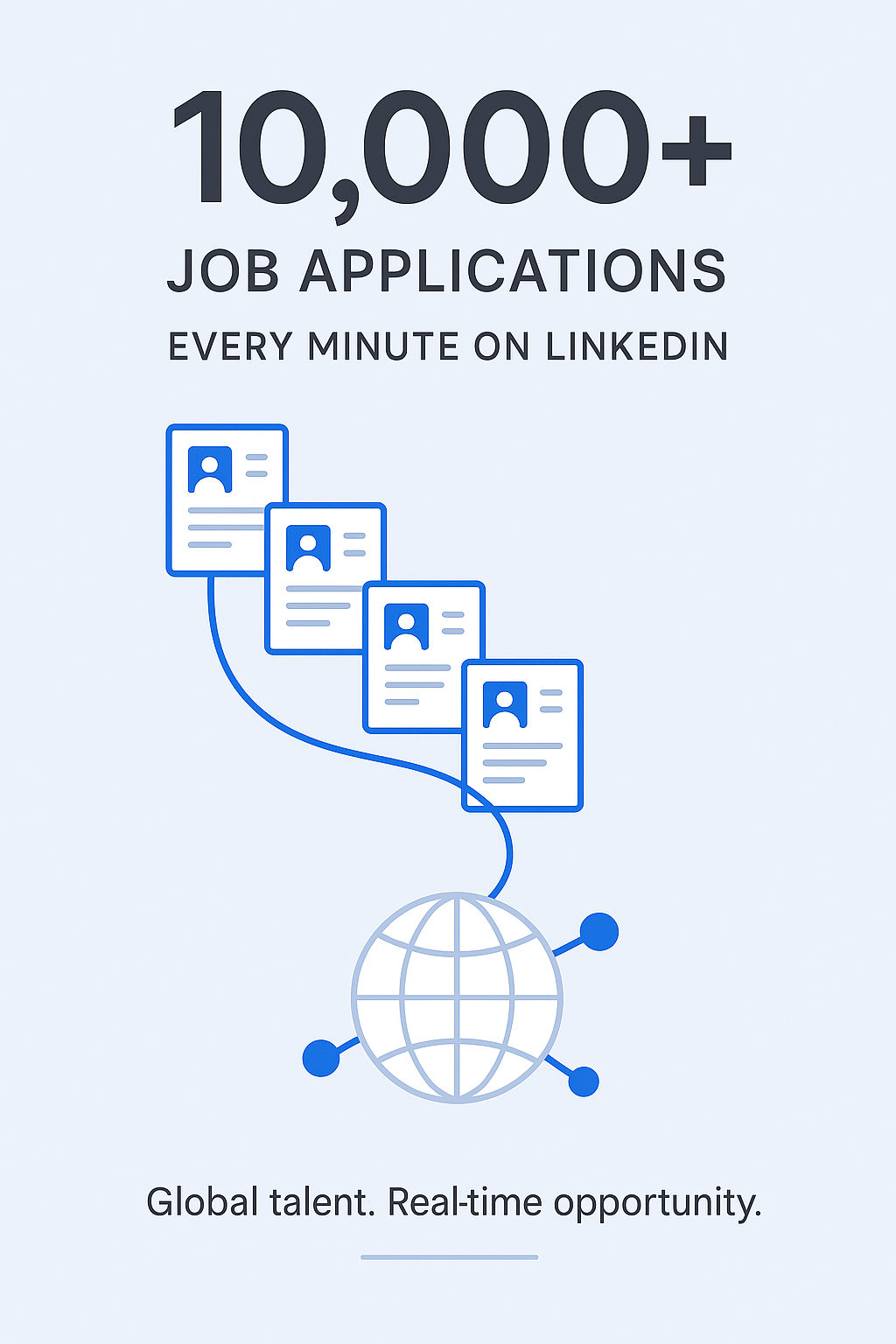


Think about your prospect—the hiring manager you’re trying to reach. If they have an open role, they’re drowning in resumes.

What this means:

  • Cut Through Noise: Generic emails get buried under millions of notifications
  • Lead with Value: If you sell HR tech or recruitment services, your opening line writes itself: “I see you’re hiring. The volume must be overwhelming…”
  • Update Your Data: Contact information becomes stale fast in this fluid market

Despite overwhelming volume, 7 people are hired through LinkedIn every minute. Decision-makers are constantly changing seats—a “Champion” leaving is a risk, but joining a new company is an opportunity.

Additionally, 65 million users search for jobs weekly. If your outbound relies on static email lists from six months ago, you’re likely bouncing 20-30% of your messages.

The “We Have Budget” Indicator

In sales, the hardest objection to overcome is “We don’t have the budget.” It’s the classic deal-killer.

But job postings are the ultimate cheat code for bypassing this objection.

Why? Because hiring costs money. It costs money to post the ad, interview candidates, and most importantly—the salary for that new role has been approved in a budget meeting somewhere. A job posting is verified proof of liquidity.

When you see a company posting multiple roles, especially in departments like Sales, Marketing, or Engineering, you’re looking at an organization that’s actively investing in growth. That’s your green light.

The Remote Work Surge

One of the most significant trends in 2025 is the resilience and growth of remote work. LinkedIn predicts a 150% increase in remote job postings by 2025.


This is a massive signal for specific types of vendors:

  • The IT Stack: Companies hiring remotely need VPNs, cloud security, and hardware logistics
  • The HR Stack: They need payroll providers who can handle multi-state or multi-country tax compliance
  • The Culture Stack: They need engagement tools, async video platforms, and collaboration software

If you see a “Remote” tag on a job posting and you sell any of the above, that’s a qualified lead. This isn’t a niche anymore—it’s a dominant market force.

The AI Boom: Following the Money

We can’t talk about 2025 without talking about Artificial Intelligence. The statistics here are explosive.

Job postings that mention “artificial intelligence” or “generative AI” have attracted 17% more applications over the past two years compared to those that don’t. Moreover, AI-related hiring has increased 30% faster than overall recruitment.


For sales pros, this is a goldmine:

  • Infrastructure: Companies hiring AI engineers are going to have massive cloud computing bills
  • Data Needs: AI needs data—these companies need datasets, storage solutions, and big data processing tools
  • Security: AI code needs to be secured, signaling a need for DevSecOps tools

When you spot AI-related job postings, you’re looking at companies with serious technical budgets and aggressive growth plans.

🎯Turn Job Postings Into Pipeline

Learn how LinkedIn outbound converts hiring signals into strategy meetings

Industry-Specific Hiring Trends

Not all industries are created equal. You want to target industries that are growing, not shrinking. The 2025 data gives us a clear heatmap of where the money is flowing

 💼 Beyond Job Boards

Use LinkedIn prospecting to reach decision-makers before your competitors

Technology & Media: The Recovery

After brutal layoffs in 2023-2024, the tech sector is showing signs of life. Hiring in the tech industry is stabilizing or showing slight recovery (+/- 0.5% year-over-year).

The Sales Insight: It’s safe to go back in the water. Accounts that were “frozen” for budget last year might be thawing. This is the time to re-engage those “Closed-Lost” opportunities from 12 months ago.

Financial Services: The Steady Fortress

Financial services remain a bastion of stability. Hiring in this sector is up 1.4%.

The Sales Insight: Banks, insurance firms, and fintechs are less volatile than pure-play SaaS companies. If you’re selling high-ticket enterprise software, this is your safest bet. They have the budget, and they’re deploying it steadily.

Government Administration: The Warning Sign

On the flip side, hiring in Government Administration has seen a significant decline, down 17.7% year-over-year.

The Sales Insight: Unless you’re a specialist government contractor, this sector is going to be tough. Long sales cycles combined with shrinking hiring budgets mean you’ll be fighting an uphill battle.

The Emerging Frontier: Green Skills

The “Green Skills Report 2025” highlights a rising demand for green talent.

The Sales Insight: This is a buying signal for ESG reporting software, compliance tools, and supply chain audit services. If a company is hiring a “Sustainability Manager,” they’re about to buy software to measure their carbon footprint.

The “Ghost Job” Phenomenon

Not every job posting on LinkedIn represents a real, immediate vacancy. There’s a growing phenomenon known as “Ghost Jobs”—roles posted to collect resumes, build a pipeline for the future, or give the appearance of growth to investors.

Some job seekers report that the application process feels less like hiring and more like a marketing funnel. Additionally, LinkedIn often counts anyone who clicks “Apply” as an applicant, even if they don’t finish the process on the company website.

Why this matters for sales:

  • Don’t rely solely on the post: Just because a job is posted doesn’t mean a hire is imminent. You need to verify the intent.
  • Look for multiple signals: A job post + funding announcement + website visit = real deal. A job post alone might be a ghost.
  • The “Noise” Opportunity: HR teams are overwhelmed with data. If you sell automation tools that filter candidates, the “Ghost Job” phenomenon proves they need help managing the influx.

💼 Beyond Job Boards

Use LinkedIn prospecting to reach decision-makers before your competitors

Data Mining and Recruitment Analytics

For sophisticated sales teams, LinkedIn is a giant database waiting to be mined. The concept of data mining here isn’t about writing code—it’s about extracting patterns.

Skills-Based Hiring: The Degree is Dying

One of the most profound shifts in 2025 is the move away from degree requirements. There’s been a 16% jump in paid job posts that don’t require a degree compared to 2020.

This changes how you research prospects:

  • Old Way: Search for “Alumni of Harvard” or “MBA”
  • New Way: Search for skills. Recruiters focusing on skills-based searches are 12% more likely to make a quality hire
  • The Opportunity: If you sell training, upskilling, or certification platforms, this is your moment

The Rise of Soft Skills

Interestingly, in a tech-dominated world, human skills are becoming premium. The skill “relationship development” now appears 54x more frequently in job requirements for recruiters.

The Implication: Automation is handling rote tasks. Companies are hiring humans to do the human stuff—building relationships. If your product helps build relationships (CRM, gifting platforms, communication tools), highlight that.

AI in the Hiring Process

Recruitment teams are adopting AI faster than almost any other department:

  • 37% of organizations are integrating or testing generative AI tools for recruitment
  • These tools are saving approximately 20% of their workweek
  • Companies using AI-assisted messaging see a 9% increase in quality hires

This tells us that the buyer persona for recruitment tools is tech-forward. They’re embracing AI. When you pitch to them, don’t hide the AI features of your product—front-load them.

LinkedIn Active Users Breakdown

To sell effectively, you need to know who’s in the room. LinkedIn has grown from a professional network into a global utility—essentially the “identity layer” for the business world.

Total User Base vs. Active Users

There’s a critical distinction between a “User” and a “Lead”:

  • Total Members: LinkedIn has surpassed 1.2 billion members globally
  • Growth Rate: It’s growing by roughly 3 new members every second
  • Monthly Active Users (MAU): The estimated MAU is around 310 million

The Sales Reality Check:

There’s a massive gap between 1.2 billion profiles and 310 million active users. That’s almost 900 million “zombie” profiles—people who created an account five years ago and haven’t logged in since.

If you’re using a cheap data provider that just scrapes LinkedIn, you’re going to get a lot of those zombies in your list. You’ll send emails that bounce, or worse, hit spam traps.

Geographic Distribution

Country

User Base (Approx.)

The Sales Play

United States

~234-243M

High value, high competition. Most expensive leads, highest potential deal size.

India

~148-161M

Volume & Tech. Fastest growing market. Center of global tech and BPO supply chain.

Brazil

~83-89M

Socially active. Highly engaged market. Cultural norms favor warmer outreach.

Europe

~304M

Compliance first. GDPR is law. Ensure cold outreach is compliant.

The Quality of the Audience

The reason B2B marketers love LinkedIn is the density of decision-makers:

  • 4 out of 5 members drive business decisions
  • Over 65 million decision-makers and 10 million C-level executives on the platform
  • 53% of users belong to households earning over $100,000 per year

Demographics:

  • The Sweet Spot: The 25-34 age group makes up about 47-60% of the user base. These are your “Champions”—the Managers and Directors who feel the pain and will advocate for your solution.
  • The Executives: The 55+ age group is small (~3%), but they hold disproportionate power. They’re harder to reach but hold the purse strings.

🚀 Access 65M+ Decision-Makers

Stop guessing who has budget—LinkedIn hiring signals show you exactly who's spending

7-day Free Trial |No Credit Card Needed.

The Cold Reach Out Ecosystem: Email vs. LinkedIn

This is the question every sales team asks: “Should I send an InMail or a Cold Email?”

In 2025, the answer is backed by hard data. It isn’t an “either/or” choice—it’s a strategic deployment of resources.

The Case for Cold Email

Cold email is the workhorse of the B2B world. It’s reliable, scalable, and you own the channel.

The Advantages:

  • ROI King: Email delivers an average ROI of $42 for every $1 spent
  • Scalability: You can send thousands of emails in the time it takes to manually send 50 InMails

The Challenge:

  • Open rates are dropping: In 2025, the average cold email open rate sits at 27.7%, down from 36% the previous year
  • This is due to stricter spam filters from Google and Yahoo

The Solution: This is where high-quality, verified contact data becomes non-negotiable. If you’re seeing low open rates, it’s often because your data is bad. Invalid addresses ruin your domain reputation.

The Case for LinkedIn InMail

InMail is the sniper rifle to Email’s shotgun.

The Advantages:

  • High Response Rates: InMail sees response rates between 10-25%, significantly higher than the 1-5% average for cold email
  • Trust Factor: When you message someone on LinkedIn, they see your face, headline, and mutual connections. It’s harder to ignore a person than an anonymous email address

The Challenge:

  • You can’t scale it: LinkedIn imposes strict limits on how many messages you can send. If you try to automate too aggressively, you’ll get banned.

The Hybrid Strategy

The data shows that multichannel outreach increases engagement by 287%.

The ideal workflow:

  1. Trigger: You see a job posting for a “VP of Marketing”
  2. Research: Visit their LinkedIn profile to understand their background
  3. Touch 1 (LinkedIn): Send a connection request: “Saw you’re hiring for X role”
  4. Touch 2 (Email): Send a value-based email: “I see you’re scaling the marketing team. Usually, that brings chaos with [Problem]. We solve that by…”
  5. Touch 3 (LinkedIn): Engage with their recent post
  6. Touch 4 (Email): Follow up

This “Surround Sound” effect makes you unavoidable.

Engagement Statistics: Getting Noticed

If you’re going to use LinkedIn as part of your outreach, you need to play by the algorithm’s rules. Posting content is “passive prospecting”—it warms up the market so that when you call, they recognize your name.

Content That Wins in 2025

  • Video: Uploads are up 34% year-over-year. Short-form, vertical video under 60 seconds is the best performing format
  • Carousels (Documents): These get a 6.1% engagement rate. Perfect for B2B educational content
  • The C-Suite Cheat: Posts from Executives get 4x more engagement than average employees

Strategic Tip: Help your CEO or VP write content. Ghostwrite for them. The reach will be massive, and you can prospect everyone who comments on their posts.

Timing Your Attacks

When should you post or send messages?

  • The Golden Window: Tuesday, Wednesday, and Thursday
  • The Hours: 9 a.m. – 12 p.m. and 1 p.m. – 4 p.m.
  • Avoid: Mondays (people are catching up) and Fridays (people are checking out)

LinkedIn Groups: A Hidden Data Source

You might hear people say LinkedIn Groups are dead. In terms of engagement? Mostly yes. But for data mining? They’re a goldmine.

The Loophole: You can message members of a group you’re in without being connected to them. This bypasses the InMail limit.

The List: You can see the member list of niche groups. If you sell to “SaaS Founders,” joining a “SaaS Founders” group gives you a pre-qualified list of thousands of leads. Use this for research, not for spamming the group feed.

Conclusion

The numbers don’t lie. In 2025, LinkedIn is not just a social network—it’s the heartbeat of the global B2B economy. With 10,000 applications per minute, 1.2 billion users, and 7 hires every 60 seconds, the data is screaming at us.

For sales professionals, the takeaways are actionable:

  • Follow the Money: Use job postings as your primary “Buy Signal.” A company hiring is a company spending
  • Verify Your Targets: With only 310 million active users out of 1.2 billion profiles, blindly scraping data is a recipe for failure
  • Diversify Your Channels: Don’t bet your quota on just InMail or just Email. Combine them

The market is moving fast. But if you use the statistics in this report to focus your efforts, you can turn big data into real results.

Want to skip the broken email lists and connect directly with decision-makers on LinkedIn? Book a free strategy session to learn our complete outbound methodology covering targeting precision, campaign design, and scaling methods that deliver 15-25% response rates.

FAQs

How many job postings are on LinkedIn in 2025?

While the total number of live jobs fluctuates, the velocity is key: LinkedIn processes over 10,000 job applications every minute. The volume of remote job postings specifically is predicted to rise by 150% in 2025.

Are LinkedIn Groups still worth it for lead generation?

For posting content? Generally, no—engagement is low. However, for data mining? Yes. LinkedIn groups allow you to identify and message niche prospects who share specific interests, bypassing some connection limits.

What is the difference between total users and active users?

LinkedIn has 1.2 billion total members, but only about 310 million monthly active users. For sales, this means roughly 75% of profiles are dormant. Always verify your contact data before reaching out.

Does mentioning AI in a job post actually matter?

Yes. Job postings that mention AI or Generative AI receive 17% more applications. This indicates that top talent is gravitating toward forward-thinking companies. For sales, an AI-related job post is a strong signal of high-tech budget.

How effective is cold email compared to InMail?

InMail has a higher response rate (10-25%) but is limited in volume. Cold Email has a lower response rate (1-5%) but offers massive scalability and ROI ($42:1). The best performers use both in a coordinated strategy.

How to Build a High-Converting B2B Sales Funnel from Scratch on LinkedIn

How to Build a High-Converting B2B Sales Funnel from Scratch on LinkedIn ​