🎉Find Prospects and Send Cold Emails & LinkedIn Outbound | All in One Place

Outbound Recruitment: The Complete Guide to Proactive Hiring

Table of Contents

Most hiring managers wait for candidates to find them. But what if I told you that sourced candidates are 5× more likely to be hired than those who apply through traditional job postings?

Welcome to the game-changing world of outbound recruitment. While others sit back hoping the right talent stumbles upon their job listing, smart recruiters are proactively hunting down the perfect candidates before they even know they’re looking.

In today’s ultra-competitive talent market, waiting isn’t a recruiting strategy—it’s surrender. The best performers aren’t scrolling job boards. They’re busy crushing it at their current roles, completely unaware that their dream opportunity is actively searching for them.

What Is Outbound Recruitment?

Think of outbound recruitment as the sales approach to hiring. Instead of casting a wide net and hoping for the best, you’re laser-targeting specific individuals who match your ideal candidate profile. You research them, reach out directly, and build relationships before they ever consider leaving their current position.

The numbers don’t lie: recruiters today are managing 56% more open job requisitions and processing over 2,500 applications per role—more than double from just a few years ago. In this chaos, outbound recruiting cuts through the noise by going straight to the source.

The Fundamental Difference Between Inbound and Outbound Recruitment

Here’s the core distinction that every hiring manager needs to understand:

Inbound recruiting is like fishing with a net. You create an attractive employer brand, post jobs on career sites, and wait for candidates to come to you. It’s passive, broad, and relies entirely on candidates actively job hunting.

Outbound recruitment is like spearfishing. You identify exactly who you want, research where they are, and make direct contact. It’s active, targeted, and reaches the hidden talent market—professionals who aren’t actively looking but might be open to the right opportunity.
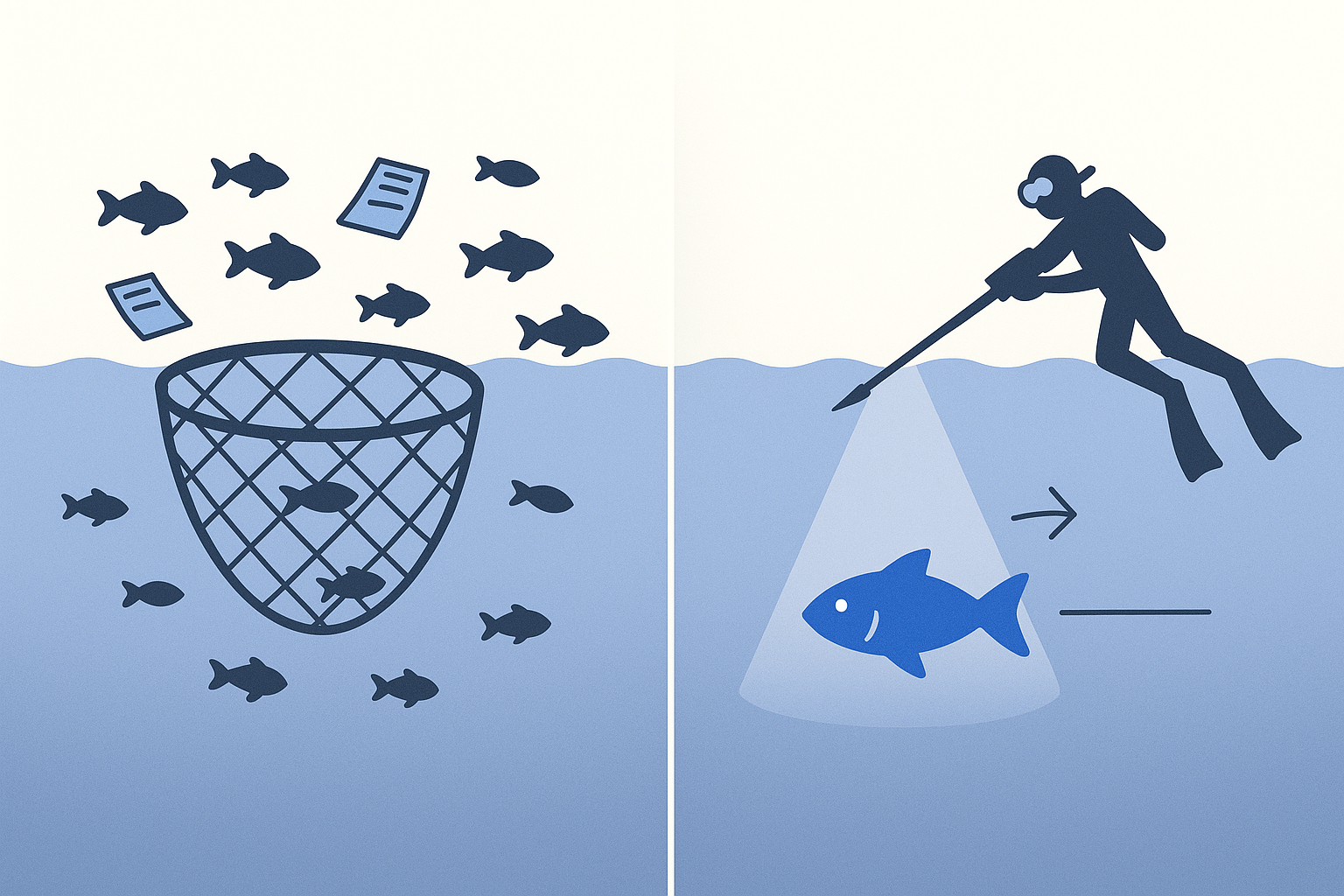
Quick Comparison: Inbound vs Outbound Recruiting

Aspect

Inbound

Outbound

Approach

Passive waiting

Active hunting

Talent Pool

Job seekers only

Hidden talent market

Time to Hire

Slower process

Faster results

Quality

Mixed results

Higher quality hires

Control

Limited

Full control

The most telling statistic? 70% of the global workforce isn’t actively job searching, but they’re open to hearing about new opportunities. That’s a massive pool of potential candidates that inbound recruiting never touches.

How to Run a Successful Outbound Recruitment Campaign

Running an effective outbound recruitment campaign follows a proven framework that mirrors successful sales processes. Here’s how to execute it:

Define Your Ideal Candidate Profile

Before you send a single message, you need crystal clarity on who you’re hunting. Create a detailed ideal candidate profile that goes beyond basic job requirements:

  • Technical skills and experience levels
  • Industry background and company types
  • Career trajectory and ambitions
  • Cultural fit indicators
  • Geographic preferences
  • Compensation expectations

This isn’t a job description—it’s a blueprint for the exact person who will excel in your role and organization.


Source Hidden Talent

The best candidates aren’t on job boards. They’re excelling at their current companies, building impressive LinkedIn profiles, contributing to industry discussions, and creating content that showcases their expertise.

Your sourcing strategy should include:

  • LinkedIn advanced search and Sales Navigator
  • Industry-specific communities and forums
  • GitHub profiles for technical roles
  • Professional association directories
  • Conference speaker lists and attendee networks
  • Employee referral networks

Pro tip: Use boolean search techniques to find candidates with specific skill combinations that others might miss.

Craft Compelling Outreach Messages

Your initial outreach determines everything. Generic messages get deleted instantly. Personalized, value-driven messages start conversations.

Every message should answer one critical question: “What’s in it for me?” Focus on the candidate’s career growth, not your company’s needs.

10 Strategies to Run a Successful Outbound Recruitment Cold Campaign

1. Treat Recruitment Like Sales Prospecting

Apply the same systematic approach you’d use for B2B sales. Research your prospects, understand their pain points, and position your opportunity as the solution to their career challenges. 61% of marketers say this systematic approach is their top priority for success.

2. Master Multi-Channel Outreach

Don’t rely on a single touchpoint. Layer your approach across:

  • Personalized LinkedIn messages
  • Direct email outreach
  • Professional phone calls
  • Social media engagement
  • Industry event networking

Research shows that multi-touch campaigns increase response rates by up to 300%.

🎯 Apply This Strategy to B2B Sales

Our LinkedIn outbound uses the same multi-channel approach for 15-25% response rates

3. Hyper-Personalize Every Message

Generic outreach is dead. Personalized subject lines alone generate 50% higher open rates. Go deeper by referencing:

  • Recent projects they’ve worked on
  • Articles they’ve published or shared
  • Mutual connections or shared experiences
  • Industry challenges they’ve discussed

Highly personalized messages with multiple customization fields can increase reply rates by 142%.

💬 Personalization That Drives Pipeline

Complete targeting, campaign design, and scaling for LinkedIn outreach that converts prospects

4. Leverage Employee Referrals Strategically

Employee referrals aren’t just helpful—they’re a goldmine. Referred candidates are not only 4× more likely to be hired but also tend to have better cultural fit and longer tenure. Create structured referral campaigns where team members proactively reach out to their networks.

5. Build Strategic Follow-Up Sequences

The first message is just the opening move. The first follow-up email brings in reply rates 40% higher than the initial outreach. Design a sequence that:

  • Follows up without being pushy
  • Adds new value in each touchpoint
  • Provides different angles on the opportunity
  • Respects the candidate’s timeline

6. Optimize for Mobile-First Reading

Nearly 25% of emails are opened on mobile devices. Keep your messages concise, scannable, and mobile-friendly. Use short paragraphs, bullet points, and clear calls-to-action that work on small screens.

7. A/B Test Your Approach

Continuous improvement is key. Test different:

  • Subject line styles (direct vs. curious)
  • Message lengths (brief vs. detailed)
  • Call-to-action phrasing
  • Send times and days
  • Personalization approaches

Track metrics like open rates, response rates, and conversion to interviews to optimize your strategy.

8. Build Talent Pipelines Before You Need Them

The most successful recruiters are always building relationships, not just when they have open roles. Nurture potential candidates through:

  • Regular industry insights sharing
  • Career development resources
  • Industry event invitations
  • Periodic check-ins on their goals

This approach reduces time-to-hire by up to 50% when positions open up.

9. Strengthen Your Employer Brand

Your outreach is only as good as the reputation that precedes it. Candidates research companies before responding. Ensure your:

  • LinkedIn company page is compelling
  • Website clearly communicates culture and values
  • Employee testimonials are visible and authentic
  • Industry presence demonstrates thought leadership

10. Leverage Technology and Automation

Modern recruiting demands modern tools. Use technology to:

  • Automate initial research and contact gathering
  • Schedule follow-up sequences
  • Track engagement and response rates
  • Manage candidate relationship data
  • Scale personalization efforts

The key is automating the process while keeping the human touch in your messaging.

⚙️ Done-For-You LinkedIn Outbound System

We handle targeting, campaigns, and scaling so you focus on closing deals

Proven Email Templates for Outbound Recruitment

Templates provide structure, but personalization brings results. Here are battle-tested approaches that consistently generate responses:

The Mutual Connection Template

Subject: [Mutual Connection] suggested we connect

Hi [Name],

I was speaking with [Mutual Connection] about exciting developments in [Industry], and they immediately mentioned you as someone doing incredible work at [Company].

I’m working with [Your Company] on a [Role Title] opportunity that might align perfectly with your experience in [Specific Area]. [Mutual Connection] felt it could be exactly the type of challenge you’ve been looking for.

Would you be open to a brief 15-minute conversation to explore if there’s potential alignment?

Best regards,
[Your Name]

The Industry Expert Template

Subject: Your insights on [Specific Topic]

Hi [Name],

I came across your recent post about [Specific Topic] and was impressed by your perspective on [Specific Detail]. Your approach to [Challenge/Solution] really resonated with our team.

Given your expertise in [Area], I thought you might find our current [Role] opportunity intriguing. We’re tackling similar challenges at [Company], particularly around [Relevant Challenge].

I’d love to share more about how this role could leverage your [Specific Skill/Experience]. Are you open to a quick conversation?

Thanks,
[Your Name]

The Direct Value Proposition Template

Subject: [Company Name] opportunity: [Specific Benefit]

Hi [Name],

I know you’re likely not actively looking (the best people rarely are), but I wanted to reach out about an opportunity that might be worth exploring.

We’re looking for a [Role Title] to [Specific Impact/Goal] at [Company]. Based on your background with [Specific Experience], I believe this could offer you [Specific Benefit/Growth Opportunity].

Even if timing isn’t right now, I’d appreciate 10 minutes to share details and get your thoughts.

Best,
[Your Name]

The Strategic Follow-Up Template

Subject: Following up on [Previous Subject]

Hi [Name],

I know you’re busy, and I don’t want to be a pest. I haven’t heard back, so I’ll assume the timing isn’t right.

Just wanted to make one final attempt to see if you’d be open to learning about the [Role Title] opportunity at [Company].

If not, no worries at all—feel free to reach out in the future if circumstances change.

Wishing you continued success,
[Your Name]

Building Your Follow-Up Sequence

A strategic follow-up sequence turns single messages into relationship-building campaigns:

Day 0: Initial Introduction
Send your primary outreach using one of the templates above.

Day 4: Value-Add Follow-Up
Share a relevant industry article or insight without mentioning your role.

Day 10: Alternative Angle
Present the opportunity from a different perspective—career growth, team culture, or project impact.

Day 18: Final Attempt
Use the strategic follow-up template to close the loop professionally.

Day 45+: Long-term Nurture
Move to occasional value-add touches to stay on their radar for future opportunities.

Measuring Success: Key Metrics to Track

Successful outbound recruiting requires consistent measurement and optimization:

  • Response Rate: Aim for 15-25% initial response rates
  • Positive Response Rate: Target 5-10% interested responses
  • Conversion to Call: Convert 50-70% of positive responses to phone calls
  • Call to Interview: Schedule interviews with 30-50% of calls
  • Interview to Offer: Extend offers to 20-30% of interviewed candidates

Track these metrics weekly and adjust your approach based on the data. Small improvements in each stage compound into dramatically better results.

📊 Results-Driven LinkedIn Outreach Engine

Proven targeting strategy and campaign design delivering 15-25% response rates consistently

7-day Free Trial |No Credit Card Needed.

Common Mistakes to Avoid

Even experienced recruiters fall into these traps:

Sending Generic Messages: Personalization isn’t optional—it’s essential for breaking through the noise.

Focusing on Company Needs: Lead with candidate benefits, not your hiring challenges.

Giving Up Too Early: Most responses come after the third or fourth touchpoint.

Ignoring Mobile Optimization: Test your messages on mobile devices before sending.

Neglecting Follow-Up: Consistent follow-up separates professional recruiters from amateurs.

Poor Timing: Research shows Tuesday through Thursday, 10 AM to 2 PM, generate the highest response rates.

The Future of Outbound Recruiting

The recruiting landscape continues evolving rapidly. AI-powered sourcing tools are making candidate identification faster and more precise. Video messages are increasing engagement rates by 200-300%. Social recruiting is expanding beyond LinkedIn to include industry-specific platforms and communities.

But technology amplifies strategy—it doesn’t replace it. The fundamentals of research, personalization, and relationship-building remain the foundation of successful outbound recruiting.

Conclusion

Outbound recruitment isn’t just another hiring tactic—it’s a complete mindset shift from reactive to proactive talent acquisition. While others wait and hope, you’re actively building relationships with top performers before they ever consider leaving their current roles.

The statistics speak for themselves: sourced candidates are 5× more likely to be hired, and companies using systematic outbound approaches reduce their time-to-hire by 50% while improving quality of hire metrics across the board.

Success requires treating outbound recruiting like a sales process: research thoroughly, personalize ruthlessly, follow up consistently, and always focus on the candidate’s career goals rather than your immediate hiring needs.

Start building your outbound recruiting strategy today. Your future hires—and your hiring success—depend on it.

FAQs

What's the difference between inbound and outbound recruiting?

Inbound recruiting waits for candidates to apply to posted positions, while outbound recruiting proactively identifies and reaches out to specific target candidates who may not be actively job searching.

How long should an outbound recruitment message be?

Keep initial messages between 50-150 words. Mobile optimization is crucial since 25% of emails are opened on mobile devices. Focus on one clear value proposition and call-to-action.

What's a good response rate for outbound recruiting?

Aim for 15-25% initial response rates and 5-10% positive responses. Highly personalized messages with multiple customization fields can achieve response rates up to 142% higher than generic outreach.

How many follow-ups should I send?

Research shows the first follow-up increasesreply rates by 40%. Plan a 4-touch sequence over 18 days, then move to long-term nurturing. Most positive responses come after the third or fourth touchpoint.

Which platforms work best for outbound recruiting?

LinkedIn remains the primary platform, but expand to industry-specific communities, GitHub for technical roles, professional associations, and social media where your target candidates are active.

Master LinkedIn Outbound That Converts

Get complete targeting, campaign design, and scaling methods for 15-25% response rates

Segmentation That Actually Converts

LinkedIn outbound targets precise demographics with strategic campaign design and scaling methods

How to Build a High-Converting B2B Sales Funnel from Scratch on LinkedIn ​