

You’ve been there. You spent all morning crafting what you thought was the perfect email. You built a list of 1,000 prospects, hit send, and waited for the flood of replies.
The result? A handful of responses, mostly polite “no thanks” messages and a few out-of-office replies. It’s frustrating, demoralizing, and feels like a massive waste of time.
This is the all-too-common outcome of traditional, broad-based outreach. But what if you could trade your shotgun for a sniper rifle? What if you could find the exact people who need what you sell and send them a message that feels like it was written just for them?
That’s the power of targeted outreach. It’s not just another buzzword; it’s a fundamental shift in strategy that turns prospecting from a numbers game into a precision-driven science.
What Is Targeted Outreach and How It Differs From Traditional Outreach
At its core, targeted outreach is a strategy that focuses on engaging specific, predefined groups or individuals with tailored messages that align perfectly with their needs, interests, and challenges. Instead of blasting a generic message to everyone, you’re having a relevant conversation with a select few.
The difference between this and the old way of doing things is night and day.
The Critical Distinction: Targeted vs. Traditional Outreach
Think of it as a sniper rifle versus a shotgun. One is about precision and impact; the other is about volume and hope.
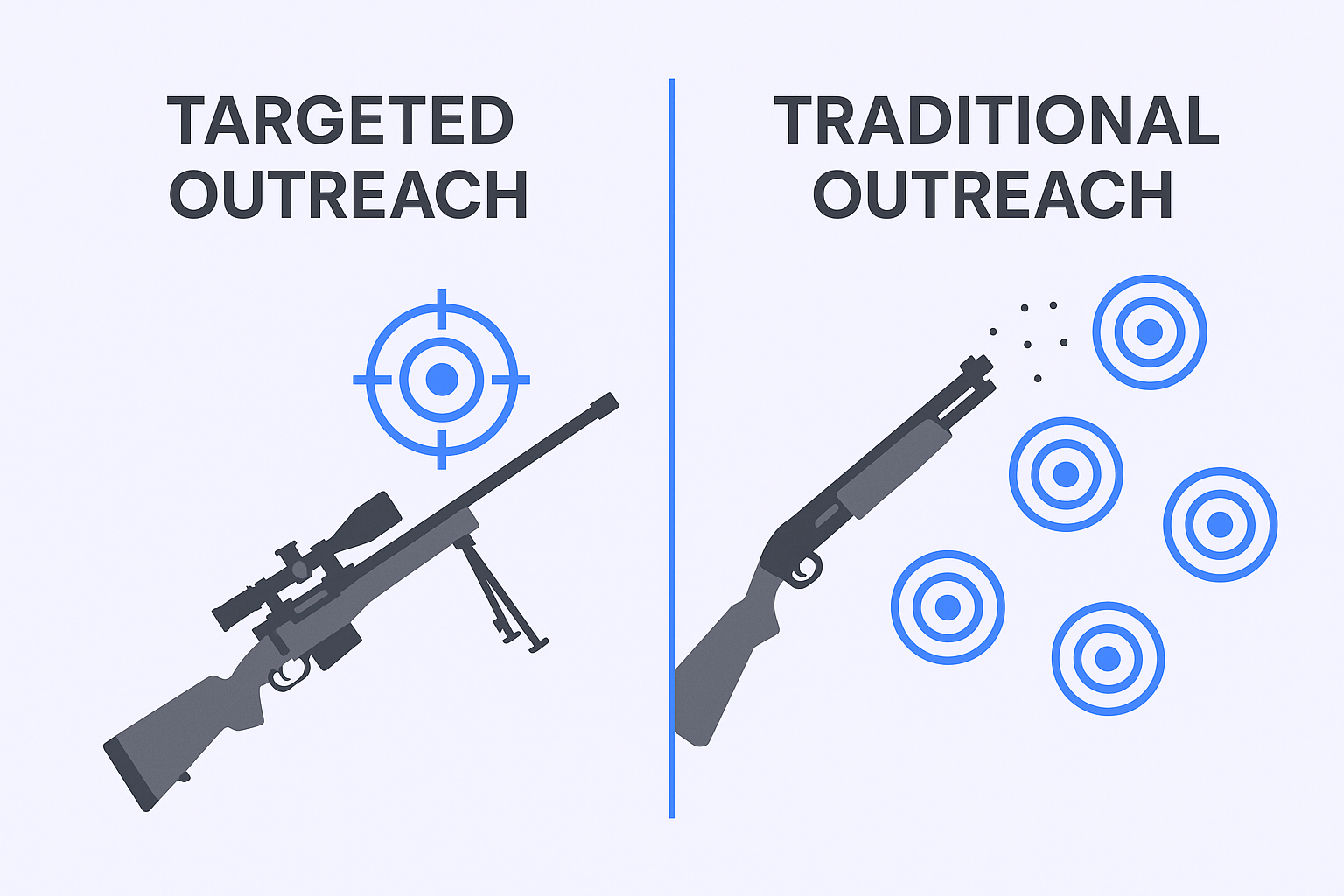
Feature | Traditional Outreach (Shotgun) | Targeted Outreach (Sniper) |
Approach | Mass messaging, one-size-fits-all | Personalized, one-to-one feel |
Audience | Broad, generic list | Carefully segmented, ICP-based |
Message | Generic, product-focused, “me-first” | Tailored to persona and pain points |
Channels | Often single-channel (e.g., email blast) | Multi-channel (email, LinkedIn, calls) |
Goal | Volume, hope for a response | Connection, starting a conversation |
Typical ROI | Low, high risk of spam reports | High, builds brand reputation |
This isn’t just a theoretical difference; it has a massive impact on your results. The data is overwhelming:
- Personalized emails deliver six times higher transaction rates than non-personalized emails
- Personalized calls-to-action (CTAs) convert 202% better than generic ones
- According to McKinsey, 71% of consumers now expect personalized interactions, and 76% get frustrated when they don’t get them
- Companies that use targeted promotions see a 1% to 2% lift in overall sales—a significant number when scaled across an entire organization
Adopting a targeted approach is more than just learning a new tactic; it’s a complete mindset shift. Traditional outreach is seller-centric—it’s focused on what you want to sell. Targeted outreach is buyer-centric—it’s focused on what problem they need to solve.
Furthermore, sticking with the old “shotgun” method comes with a hidden, compounding cost. Mass emailing to poorly vetted lists inevitably leads to high bounce rates and spam complaints. In response, email providers like Google and Outlook are constantly tightening their filters. This creates a vicious cycle: a broad approach damages your sender reputation, which means even your well-crafted emails start landing in the spam folder.
Types of Targeted Outreach Strategies & When To Use Them
For busy professionals who need the highlights now, here’s the cheat sheet. These are the core strategies and when to deploy them.
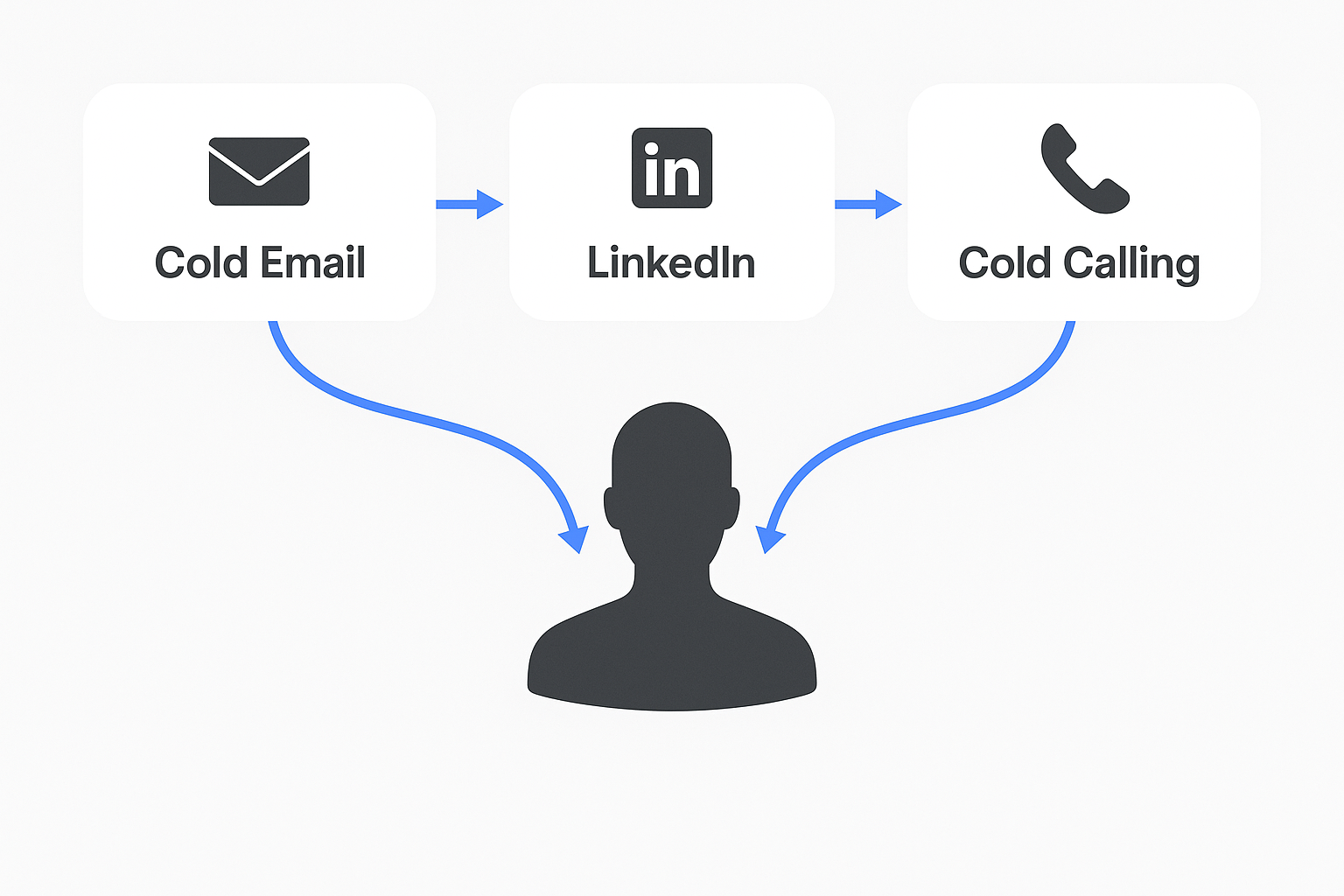
- Cold Email: This is your most scalable channel for direct outreach. Use it when: You have a clear, compelling value proposition that can be communicated concisely, and you need to reach a large number of well-defined prospects efficiently.
- LinkedIn: This is your platform for building relationships and establishing social proof. Use it when: You want to warm up a prospect before you pitch, leverage mutual connections to build trust, and engage with decision-makers in a professional context where they are already active and sharing information.
- Cold Calling: This is your high-impact channel for high-value targets. Use it when: The potential deal size is significant, the sales cycle is complex, or you need to have a nuanced, real-time conversation to uncover deep-seated pain points and get immediate feedback.
How to Execute a Targeted Cold Email Campaign
Let’s be honest: cold email has gotten harder. With inboxes more crowded than ever, the average B2B cold email reply rate has dipped to just 5.8%. This means a generic, untargeted approach is doomed to fail. But cold email absolutely still works—if you do it right.
Build Your Sniper List (The Foundation of Everything)
You can write the most brilliant email in the world, but if you send it to the wrong person, it doesn’t matter. The quality of your prospect list is the single most important factor in your campaign’s success. A poorly targeted or outdated list is one of the top reasons outreach campaigns fail.
This is where you must start with a crystal-clear Ideal Customer Profile (ICP). An ICP defines the perfect-fit company for your solution, based on firmographics like industry, company size, location, and technology used. Once you have your ICP, you can build buyer personas for the specific people you need to reach within those companies.
With your ICP and personas defined, the next step is to get accurate contact information. Using a reliable source for verified email addresses is non-negotiable. An unverified list leads to high bounce rates, which is a major red flag to email providers and the fastest way to destroy your domain’s sending reputation.
Craft a Hyper-Personalized Message (That Doesn’t Sound Creepy)
Personalization is more than just dropping {{First Name}} into a template. True personalization is about making your message relevant. Your prospect should read the first line and immediately think, “Okay, this person did their homework.”
Here are a few places to find powerful personalization triggers:
- LinkedIn Profile: Look for recent posts, articles they’ve written, promotions, or work anniversaries
- Company News: Check their company’s blog or news section for recent funding announcements, new product launches, or executive hires
- Shared Connections: Mentioning a mutual connection is one of the warmest ways to open a cold email
Template 1: The “Relevant Event” Angle
This template works because it’s timely and shows you’re paying attention to their world.
Subject: Congrats on the new funding round!
Hi {{First Name}},
Saw the big news about {{Company Name}}’s Series B—congratulations to you and the team.
Typically, after a major funding round, scaling the sales team becomes a top priority. I work with fast-growing SaaS companies like yours to help them ramp new reps faster and ensure they hit the ground running with high-quality, verified prospect data.
I am looking to set aside 15 minutes next week to share a few ideas on how you can maximize the ROI on your new hires.
How does Tuesday at 2pm or Thursday at 10am look?
Best,
Template 2: The “Solving a Specific Pain Point” Angle
This template is direct, focuses on a likely challenge, and uses confident language to prompt a response.
Subject: Question about your SDR tech stack
Hi {{First Name}},
I noticed you’re hiring several new SDRs at {{Company Name}}.
From my experience working with other VPs of Sales in the {{Industry}} space, a common challenge during rapid growth is equipping new reps with accurate data so they don’t waste time on bad leads.
We help solve this by providing a database of 95%+ accurate, human-verified contacts, so your team can focus on what they do best: booking meetings.
Let’s set some time this week to discuss if this is a priority for you.
Notice the language used in these templates. Phrases like “I am looking to” and “Let’s set some time” are examples of assumptive language. This small change from passive phrases like “I was hoping to” or “I’d love to” conveys confidence and authority. According to one study, emails using assumptive language see response rates up to 15% higher.
Automate Your Follow-ups (Without Sounding Like a Robot)
Most positive replies don’t come from the first email. Research consistently shows that you need to follow up 3-5 times to maximize your chances of getting a response. Giving up after one attempt is one of the biggest and most common outreach mistakes.
However, the strategy for follow-ups is evolving. While persistence is key, you also have to respect the prospect’s inbox. In fact, recent data from 2024 shows a startling trend: while the first follow-up provides a significant lift, adding a third email to the sequence (the second follow-up) can actually decrease reply rates by up to 20% compared to previous years.
This shift is a direct result of extreme inbox fatigue. Buyers are overwhelmed and have a lower tolerance for long, automated sequences. The modern approach is no longer about sheer persistence; it’s about providing progressive value. Each follow-up should offer a new piece of information, a different insight, or a helpful resource—not just a “bumping this to the top of your inbox” message.
Here’s a simple, effective 2-step follow-up sequence for 2025:
Email 2 (3 days after Email 1): Reply to your original email. Keep it short.
Subject: Re:
Hi {{First Name}},
Just wanted to quickly follow up on my email below.
We recently published a case study on how {{Similar Company}} increased their meeting booking rate by 30% in their first quarter with us. Thought you might find it relevant.
Let me know if you’re open to a brief chat next week.
Email 3 (5 days after Email 2): The “breakup” email. This creates a sense of respectful closure and often triggers a response.
Subject: Re:
Hi {{First Name}},
I’ve tried to connect a couple of times without success. It seems like now might not be the right time to discuss improving your team’s prospecting data.
I won’t reach out again, but please feel free to get in touch if this becomes a priority down the road.
Best,
The pressure to personalize every email while also hitting high activity metrics creates a difficult situation. You need quality, but you’re often measured on quantity. This tension is precisely why AI-powered outreach tools have become essential. These platforms are no longer just for scheduling emails; they are for achieving personalization at scale.
How to Do Targeted Outreach Via LinkedIn
LinkedIn is not just another inbox; it’s a professional social network. The rules of engagement are different. A hard pitch in a connection request is the equivalent of walking up to a stranger at a conference and immediately asking for their business. The goal here is to connect, converse, and build rapport before you ever think about selling.
Optimize Your Profile as Your Personal Sales Page
The very first thing a prospect will do after receiving your request is click on your profile. Your profile should not read like a resume; it should function as a sales page that speaks directly to your ideal customer.
Here’s a quick optimization checklist:
- Professional Photo: A clear, recent headshot where you look approachable. Your face should take up about 60% of the frame
- Benefit-Driven Headline: Don’t just put “Sales Rep at [Company Name].” Instead, try something like: “Helping Sales Leaders at B2B SaaS Companies Exceed Quota with Actionable Prospecting Data”
- “About” Section: This is your mini-landing page. Don’t talk about yourself. Talk about the problems your customers face and how you help solve them. End with a clear call-to-action, like a link to your calendar or a relevant case study
Send Connection Requests That Don’t Get Ignored
Should you add a note to your connection request? The data says yes, absolutely. One recent study found that adding a personalized message to your request can result in a 9.36% response rate, compared to just 5.44% for requests sent with no message. The key is to keep it short, professional, and non-salesy.
Template 1: The Mutual Connection
Hi {{First Name}}, I noticed we’re both connected with {{Mutual Connection’s Name}} and are both in the B2B tech space. It would be great to connect and learn from your experience.
Template 2: The Shared Interest/Group
Hi {{First Name}}, I see we’re both members of the “SaaS Growth Hacks” group. I enjoyed your recent comment on the post about outbound strategies and would love to connect.
Engage Before You Pitch (The Warm-Up Routine)
This is the step that 90% of reps skip, and it’s what will set you apart. Don’t just connect and immediately slide into their DMs with a pitch. You need to warm them up first.
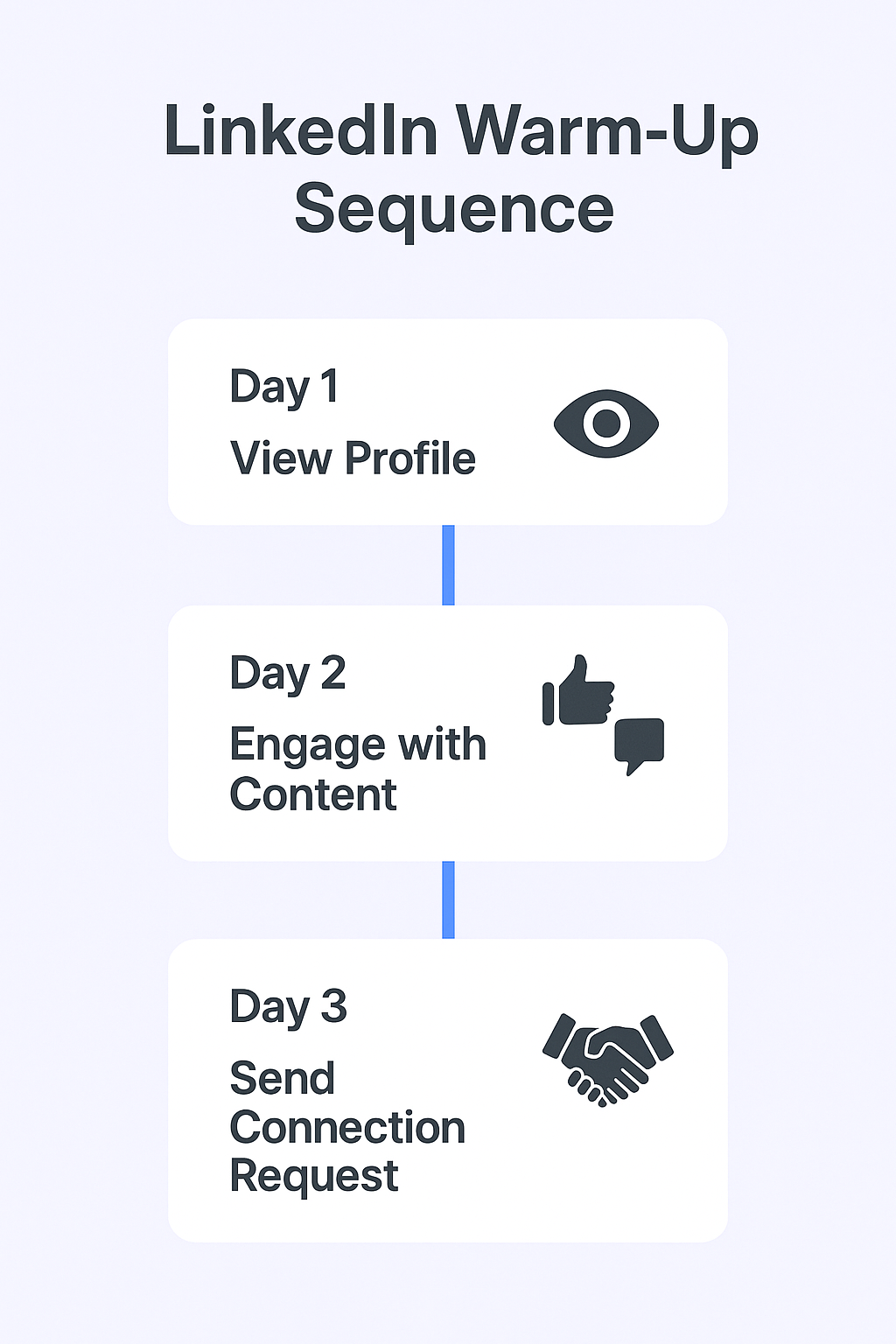
Try this simple 3-day warm-up sequence:
- Day 1: View their profile. They’ll get a notification, which puts you on their radar
- Day 2: Follow them. A few hours later, find a recent post they shared and leave a thoughtful comment or a like
- Day 3: Send your personalized connection request
Send a Targeted, Value-First Message
Once they’ve accepted your request, wait at least a day before sending a message. And when you do, do not pitch. Your first message should be about them, not you. The goal is to start a conversation by providing value.
Here’s an example:
Thanks for connecting, {{First Name}}! I was just looking at your company’s official website and saw you recently launched your new integration marketplace. That’s a huge milestone.
I recently read a great article on how companies in your space are driving adoption for new platforms post-launch. Thought you might find it interesting: [Link to article].
Cheers,
This approach works because it’s helpful, demonstrates you’ve done your research, and asks for nothing in return. It positions you as a thoughtful resource, not just another salesperson.
Your activity on LinkedIn—the content you share, the comments you leave—is a public performance of your professional brand. Prospects are researching sellers just as much as sellers are researching them. By consistently adding value and participating in industry conversations, you build authority. This makes your outbound messages feel “warmer” because you’re no longer a stranger; you’re a recognized name in their feed.

